Rumpelstiltskin AI Prompt: Photos, Roles & Six-Shot Direction
Write a Rumpelstiltskin AI video prompt that keeps the dancer and spectator separate. Learn image ordering, camera beats and what to change first.
Give each identity one role before describing the dance. In a single-person remix, @Image1 is your chosen dancer or spectator. In duo mode, @Image1 dances and @Image2 reacts; the barn and footwork references follow them. Describe the same cast throughout a six-shot, 15-second sequence.
Start with who does what
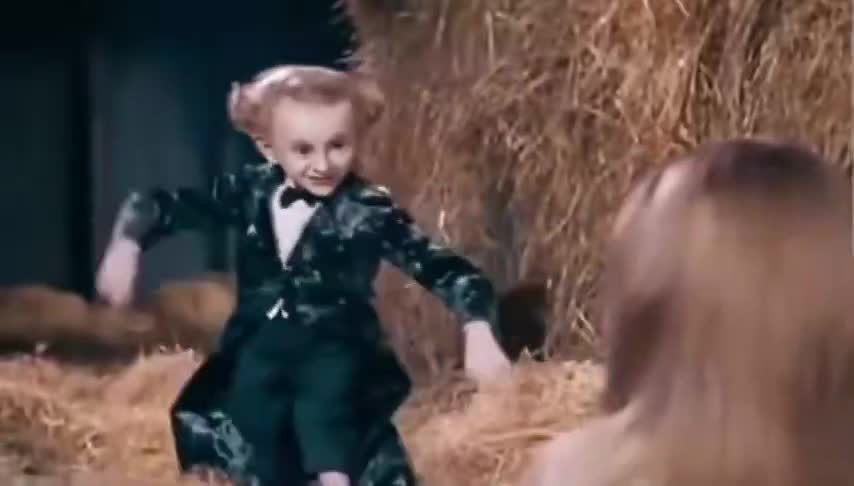
A prompt that says “replace the people” leaves too much room for interpretation. Say which uploaded person performs and which one stays seated. In a two-photo meme, a useful opening is: “@Image1 is the tiny tuxedoed dancer. @Image2 is the full-size seated spectator. Keep those identities separate in every shot.”
The scene references establish the barn and footwork, not another face to imitate. Do not describe a scene screenshot as the identity photo. Adding several extra images of the original dancer can make it harder for your intended portrait to remain the main identity.
Write the scene as something a camera can record
Begin with three seconds of a wide view: dancer on one side, seated spectator on the other. Move to a reaction close-up, then back to the shuffle and arm movements. A short feet detail makes the tiptoe readable; finish with both people in the frame and one last reaction.
Those six beats give the model a sequence rather than a bag of adjectives. Describe the direction and scale of a movement when it matters: heel lifts, small lateral steps, bent elbows, a turn toward the spectator. “Funny, viral, cinematic” does not tell the character where to put a foot.
Change one thing after the first result
Rumpel includes a complete role-specific prompt, so the first attempt does not need a rewrite. If the dancer looks right but the spectator changes identity, strengthen the spectator assignment instead of changing the lighting, choreography and clothes at the same time. If the scene is too busy, remove optional references before adding another paragraph.
Keep the tiny dancer scale, dark tuxedo and straw-filled room if you want the result to read as this meme. You can change expressions or the intensity of the performance without losing the setup. More detail helps only when the instructions agree with each other.
A written storyboard recreates; it does not trace
The production generator uses identity images and two scene stills, with no reference video submitted to the model. It makes new footage, so it can change the order of steps or a camera angle even with careful instructions. If you need the original movement unchanged, use the caption editor over the existing clip.
At the moment, videos are 15 seconds in 16:9, with 480p and 720p options. Review likeness, role separation and the wide shots as well as the dancing close-up. A single flattering frame is not enough to judge a two-person result.
Looking for a Rumpelstiltskin Midjourney prompt?
Midjourney image prompts are useful when you want to design a still scene first: the miniature performer, a reaction portrait or the barn itself. A video storyboard has a different job. It tells the performer what to do over time and keeps the roles consistent when the camera changes.
Our separate 1987 dark fantasy prompt workshop has editable still-image recipes with copy buttons. Start there for the old-film look, then return here to describe the movement. If you just want your selfie in the dance, the photo generator already supplies the starting scene and storyboard.
Copy a 1987 dark fantasy or Rumpelstiltskin Midjourney prompt
Sources: Midjourney — Style Reference
Questions you may have
Do I need to write a prompt from scratch?
No. Each role has a default storyboard. You can edit it after choosing dancer, spectator or duo.
Can I upload the original video as a reference?
The current workflow uses photos and scene screenshots, not a reference-video upload.
Does a longer prompt guarantee the exact dance?
No. Clear roles and consistent directions are more useful than length. Still-image recreation can change the choreography.
Make your own version
Keep the existing dance and add a free caption, or use a photo and credits to generate a new cast.
Start creating